Political polarization: Is this the real threat to democracy?
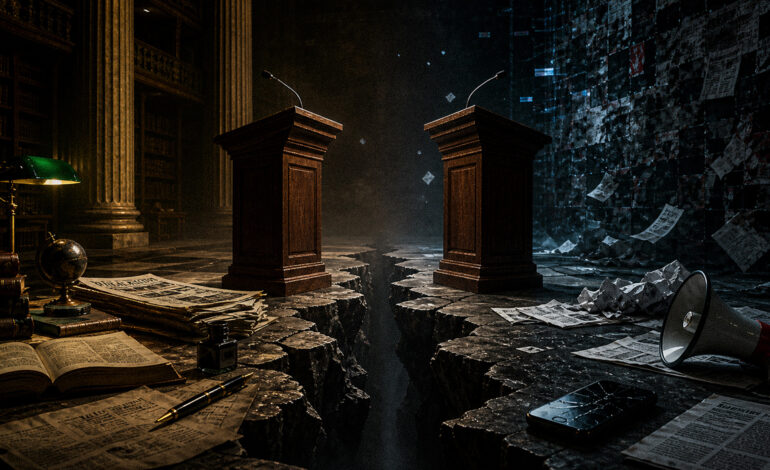
If democracy dies in the silence of forced consensus, it rots away in the deafening clamour of incivility.
Contemporary political analysis is mired in a lazy diagnosis: polarization. It is spoken of as if it were an unprecedented pathology, a virus that suddenly infected the social body and destroyed democratic harmony. However, this narrative ignores the obvious. Polarization, at its core, has always been the engine of history. Divergent worldviews are what sustain pluralism, and ever since modern political thought took hold, politics has been recognized as an imperfect mechanism for resolving conflicts through the exercise of power. The problem we face today is not the existence of opposing poles, but the degradation of the raw material that sustains debate: society itself.
What has changed is not the existence of deep-seated differences, but the way society reacts to them. We have moved from an era of elegant and intellectually rich political debate—where clashes centered on defending the perspectives of each side involved—to a landscape of ridicule and humiliation. The crisis is not ideological; it is one of behavior. We are not suffering from an excess of political discussion, but from an acute deficit of civility and of arguments grounded in knowledge and intelligence. As Hans Morgenthau rightly warned in his reflections on realism, law and norms have never had the necessary strength to replace the politics of power. What we are witnessing today is not the collapse of an established order, but rather the end of a collective fantasy about how we should behave in the face of dissent.

Can the shift in public sentiment explain the radicalization?
To understand how society has gone off the rails, one need only look at the evolution of Brazilian comedy. Comedy has historically been the most sensitive barometer of a nation’s intellectual health. In the past, figures like Jô Soares and Chico Anysio approached politics with a sophistication that demanded more from the audience than mere cheering: it demanded a broader understanding. Even under the weight of dictatorial regimes, criticism was woven with elegance and characterization. There was a concern for the text and for preserving a certain dignity on stage. Laughter was a byproduct of intelligence. And in this way, it even managed to circumvent the censorship of the undemocratic regimes that governed Brazil.
Today, that substance has been replaced by the spectacle of mockery. The contemporary stand-up comedian often limits himself to holding a microphone to ridicule the outsider, the different, or the anonymous member of the audience. Pranks and social media humor create deliberate situations to make others feel bad, turning other people’s discomfort into cheap entertainment. This transition from elegant humor to mockery is a true reflection of our political decline. If we are no longer capable of laughing intelligently at our own condition, we will hardly be able to debate national projects without resorting to violence or arson. Humor has ceased to be an instrument of political provocation and has become a mechanism of social humiliation. It is no longer necessary to circumvent censorship. Nor is it necessary to rely on talent. In many cases, all it takes is striking the right tone and going viral. And the consequences of these conveniences are profound.
The intellectual elegance of the past: nostalgia or historical fact?
As we look at this transition, we must be careful not to fall into the trap of unrealistic nostalgia. It is undeniable that the “elegant politicization” of the past was, to a large extent, the privilege of a small intellectual elite, while the majority of the population was excluded from public debate. The democratization of access to information and the advent of social media have brought millions of new voices into the political arena, and, inevitably, noise and vulgarization have come along with inclusion. However, recognizing that the debate has become widespread does not negate the fact that Brazilian history is replete with examples where deep polarization coexisted with civility, serving as a beacon for what we should aspire to today.
In the 1950s and 1960s, for example, the economic polarization between liberals and national-developmentalists was led by figures such as Roberto Campos and Celso Furtado. Representing diametrically opposed views on Brazil’s future, they debated publicly and vied for narrative dominance in the country through books and articles. The clash was visceral, yet conducted with deep academic respect and recognition of each other’s genius.
Even in recent history, during the National Constituent Assembly (1987–1988), politicians who had been mortal enemies during the military dictatorship sat at the same table. Despite extreme tensions over the nation’s future, figures such as Ulysses Guimarães ensured that disagreements were resolved through debate and voting. The democratic process remained intact, proving that it is possible to disagree radically without destroying the bridges of coexistence.
The Stigma of Radicalization, Amplified by Social Media
The fundamental question we must ask ourselves is not whether polarization is negative or harmful, but rather how this polarization plays out in practice and what its effects are. In a mature democracy, there would be no intrinsic problem with being far-right or far-left. Freedom of thought allows for extremes. The breakdown occurs in action. The problem is not the conviction, but the individual who believes that their political position authorizes them to attack those who disagree or to destroy others’ property under the pretext of social justice. As Christopher John Matthews observes in systematizing the concept of hard-nosed politics, rational actors use the tools at their disposal to maximize results, but the game requires knowledge of the rules. When society ignores the rules of civility, the game turns into barbarism.
This phenomenon is amplified by the digital environment. Social media does not merely reflect society; it distorts social reaction. The dynamics of these platforms encourage instinctive reactions rather than narrative construction. Robert Dahl identifies narrative hegemony as an essential element in pluralistic competition, but what we see today is the replacement of narrative with shouting. The result is a mass of people oblivious to the actual substance of politics, yet deeply engaged in hating their adversary. Society has shifted from debating ideas to virtual lynching, where ridiculing the other is valued more than the validity of the argument.
The Rebuilding of Democratic Maturity
Politicization and the existence of extremes are not, in and of themselves, a bad thing. On the contrary, depoliticized societies are easy prey for authoritarianism. The real danger lies in how this politicization impacts the current social fabric. When politics ceases to be a mechanism for resolution and becomes a license for aggression, institutions lose their moral authority. As Steven Levitsky and Daniel Ziblatt aptly put it, modern democracies do not die solely from coups, but erode silently when actors cease to practice self-restraint.
Ethics without power is impotence; power without limits is tyranny. The maturity of a nation does not lie in the absence of conflict, but in the ability to keep it within the bounds of civility. Brazil needs to rediscover that elegance in conduct and rigor in argument are not empty formalities, but the only defenses we have against the erosion of our coexistence. If the mood has changed because society has changed, politics will only regain its grandeur when citizens understand that their convictions end where the integrity of others begins. The contemporary challenge is not to end polarization, but to civilize it. We need to abandon mockery and reclaim our intellect.
Barbarism and aggression are not shortcuts to victory, but clear proof that politics has already failed; in a true democracy, the force of argument will never need to resort to the argument of force.